How we work
Seven rules, in order
We don't switch on an AI and leave it to work blind. We wrote these rules after getting things wrong, one at a time, and they're the reason a team of agents turns out work that holds up rather than work that merely looks finished.
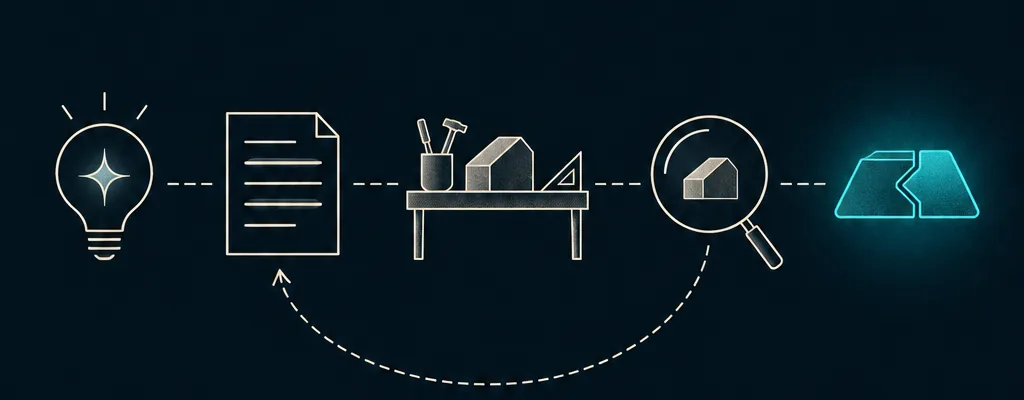
One person decides and answers. A team of AI agents does the work. Everything gets checked.
Our mission is to bring human and machine together as one. Day to day, it's concrete: Kevin decides what gets done, and he's the one who answers you. Roan, his agent, breaks the work into briefs and hands them to the team, where each agent has a trade and its limits. Whoever builds something never checks it; another agent does, and if it fails, it goes back. It's built this way to make fewer mistakes and waste less time.
Plan first, then build
Before a single line of code, this site had a reference study and a full design: colours, type and copy. Building without a plan is only faster until the first change of mind.
One brief, written criteria
Every job starts from a sheet with a single goal and a list of what has to be true for it to be done. If a criterion can't be checked, we rewrite the criterion.
One piece perfect, then the next
The Office's characters weren't all made at once. Roan and Seth came first and were taken to final quality. Only when those two were right did the other nine follow.
A picture next to the reference
Whoever delivers something you can see puts it beside the thing it was meant to look like: the board and the model, the before and the after. Looking at your own work alone, you can talk yourself into anything.
Measure before and after
The Server room has twenty-four identical racks. In full detail they cost 94,000 triangles; seen from a distance they now use 400 each, and nobody noticed. We know because we measured.
Security review before going live
Nothing gets into the running system until an agent other than its author has read it looking for a way to break it. What they find gets fixed, then checked again.
Kevin decides
Story, style, spending, accounts and publishing are his. For everything else, Roan acts without asking. This site, for one, stayed a draft on our PC until he said so.
What we can do
Custom agents
An agent with one clear job, its own rules and its own limits. Example: Seth, who reviews other agents' code and isn't allowed to touch his own.
Systems that coordinate them
Who assigns, who checks, what waits for a person. Example: Roan OS, which we use every day.
3D and voice tools
Interfaces you can look around in and talk to. Example: our 3D Office, and the voice check that knows who's in charge.
Review before release
A way of not shipping surprises. Example: the release folder, and reviews graded high, medium and low.